




';
}
// Same .tc-room skeleton as renderRoomRow (avatar/info/top/bottom) so a group row matches the
// 1:1 rows visually — data-type="group" + data-gid instead of data-cid/data-uid is what the
// click-delegation in renderRooms() switches on. No online/typing indicator (doesn't apply to
// a group), and the avatar is a rounded square instead of a circle as the only visual cue
// distinguishing a group from a person, mirroring common chat-app convention.
function renderGroupRow(group) {
var gid = group.gid;
var name = group.name || '';
var lastMsg = group.lastMessage;
var preview = '';
if (lastMsg) {
preview = parseDisplayText(lastMsg.msm);
if (!preview) {
if (lastMsg.urlima && lastMsg.urlima.indexOf('public://') >= 0) preview = '📷';
else if (lastMsg.urlaudi && lastMsg.urlaudi.indexOf('public://') >= 0) preview = '🎵';
}
if (String(lastMsg.whosend) === String(userId)) preview = 'You: ' + preview;
} else {
preview = 'No messages yet';
}
var timeStr = group.updated ? fmtTime(unixToDbTimestamp(group.updated)) : '';
var unread = group.unreadCount > 0;
var active = activeGid === gid;
return '
';
}
var body = '';
if (msg.urlima === '_loading_') {
body += '
📷 Sending…
';
} else if (msg.urlima && msg.urlima.indexOf('public://') >= 0) {
var src = msg.urlima.replace('public://', FILES_BASE);
body += '';
}
if (msg.urlaudi && msg.urlaudi.indexOf('public://') >= 0) {
var asrc = msg.urlaudi.replace('public://', FILES_BASE);
body += '';
}
if (meta && meta.type === 'loc') {
body += locationLinkHtml(meta.lat, meta.lng);
} else if (!isSalt && text) {
body += '
' + linkifyText(escHtml(text)) + '
';
}
var time = fmtTime(msg.timestamp || '');
return '
'
+ metaHtml + body
+ '' + escHtml(time) + ''
+ '
';
}
// ── Render group messages ────────────────────────────────────────────────────
function renderGroupMessages(gid) {
var msgs = allGroupMsgs[gid] || [];
var $el = $('#tc-msgs');
var order = msgs.slice().reverse();
$el.html(order.map(renderGroupMsg).join(''));
$el.scrollTop($el[0].scrollHeight);
}
// Same shape as renderMsg(), plus a sender-name label on incoming bubbles — unlike a 1:1
// conversation, "not me" doesn't tell you who actually sent it. Reuses the identical
// urlima/urlaudi rendering, so images/audio sent from the Android app (or sendGroupImage()
// here) display correctly. Audio still has no send control in this web widget.
function renderGroupMsg(msg) {
var isMe = String(msg.whosend) === String(userId);
var side = isMe ? 'tc-out' : 'tc-in';
var parsed = parseInlineMeta(msg.msm || '');
var text = parsed.text;
var meta = parsed.meta;
var isSalt = (text.length === 18 && text.indexOf(' ') < 0);
var senderHtml = '';
if (!isMe) {
senderHtml = '
' + escHtml(msg.senderName || msg.whosend) + '
';
}
var metaHtml = '';
if (meta && meta.type === 'fwd') {
metaHtml = '
';
}
// ── Send (opc 11) ────────────────────────────────────────────────────────────
function sendMessage() {
var text = $.trim($('#tc-input').val());
if (!text || !activeCid) return;
$('#tc-input').val('').focus();
isTyping = false;
post({ opc: '11', userid: userId, cid: activeCid, msm: text, fid: '0' })
.then(function (resp) {
if (!resp) return;
var ok = (resp.resp === 3 || resp.resp === '3' ||
resp.resp === 11 || resp.resp === '11');
if (!ok) return;
var msg = {
id: resp.lastmid || String(Date.now()),
whosend: String(userId),
msm: text,
urlima: '',
urlaudi: '',
timestamp: new Date().toISOString().replace('T', ' ').substr(0, 19)
};
if (!allMsgs[activeCid]) allMsgs[activeCid] = [];
allMsgs[activeCid].unshift(msg);
renderMessages(activeCid);
if (socket && socket.connected) {
socket.emit('send-message', {
id: resp.lastmid,
chatId: activeCid,
from: String(userId),
to: String(activeUid),
message: text,
type: 'text'
});
}
});
}
// ── Send group message ───────────────────────────────────────────────────────
// Purely socket-based — group-message-send both persists (tc_group_message, via the
// signaling server) and delivers, unlike 1:1's HTTP-then-socket-notify split. The server
// echoes the message back to the sender too (see group-message-send in signaling-server-2.js),
// so onGroupSocketMessage() is what actually appends it here — no optimistic local insert.
function sendGroupMessage() {
var text = $.trim($('#tc-input').val());
if (!text || !activeGid) return;
if (!socket || !socket.connected) return;
$('#tc-input').val('').focus();
isTyping = false;
socket.emit('group-message-send', {
gid: parseInt(activeGid, 10),
from: userId,
message: text,
type: 'text',
localId: 'web-' + Date.now() + '-' + Math.random().toString(36).substr(2, 8)
});
}
// ── Send group image (group-message-send, type:"image") ─────────────────────
// Unlike 1:1 (HTTP upload then socket notify), groups have no HTTP upload endpoint —
// the server expects the raw file as a base64 string on the same socket event used for
// text (see group-message-send in signaling-server-2.js), and does its own resize/compress
// (sharp, 1024x1024 max, jpeg75) server-side before writing it and echoing "group-message"
// back to every member including the sender. That echo is what onGroupSocketMessage() uses
// to both confirm this optimistic placeholder (matched by localId) and actually display it.
function sendGroupImage(file) {
if (!activeGid) return;
if (!socket || !socket.connected) return;
if (pendingGroupImage) return; // one at a time — button is disabled meanwhile anyway
var gid = activeGid;
var localId = 'web-img-' + Date.now() + '-' + Math.random().toString(36).substr(2, 8);
pendingGroupImage = { gid: gid, localId: localId };
if (!allGroupMsgs[gid]) allGroupMsgs[gid] = [];
allGroupMsgs[gid].unshift({
id: localId, localId: localId, whosend: String(userId), senderName: myName,
msm: '', urlima: '_loading_', urlaudi: '', created: Math.floor(Date.now() / 1000)
});
renderGroupMessages(gid);
$('#tc-img-btn').attr('disabled', 'disabled');
// Safety net — if the server/socket never answers at all (disconnect mid-flight etc.),
// don't leave "Sending…" stuck forever (see the 1:1 image-send bug this mirrors).
var timeoutId = setTimeout(function () { onGroupMessageError({}); }, 20000);
compressImageIfNeeded(file, function (uploadFile) {
var reader = new FileReader();
reader.onload = function () {
clearTimeout(timeoutId);
if (!pendingGroupImage || pendingGroupImage.localId !== localId) return; // already cleared
var base64 = (reader.result || '').split(',')[1] || '';
if (!base64 || !socket || !socket.connected) { onGroupMessageError({}); return; }
socket.emit('group-message-send', {
gid: parseInt(gid, 10),
from: userId,
message: '',
type: 'image',
filedata: base64,
localId: localId
});
};
reader.onerror = function () {
clearTimeout(timeoutId);
onGroupMessageError({});
};
reader.readAsDataURL(uploadFile);
});
}
// Clears whatever group image send is currently in flight — used both for explicit
// "group-message-error" replies (bad file, not a member, rate-limited) and the
// client-side timeout above. Doesn't distinguish by localId: only one send is ever
// in flight at a time (the button is disabled meanwhile), so there's nothing to match.
function onGroupMessageError(data) {
if (!pendingGroupImage) return;
var gid = pendingGroupImage.gid;
var localId = pendingGroupImage.localId;
pendingGroupImage = null;
$('#tc-img-btn').removeAttr('disabled');
if (allGroupMsgs[gid]) {
allGroupMsgs[gid] = allGroupMsgs[gid].filter(function (m) { return m.localId !== localId; });
}
if (activeGid === gid && isOpen) renderGroupMessages(gid);
if (data && data.error) { console.warn('group image send failed:', data.error); }
}
// Resizes/re-encodes as JPEG when a file exceeds COMPRESS_THRESHOLD. Skips GIFs —
// redrawing to canvas would flatten an animated GIF to a single static frame.
// Falls back to the original file untouched if decoding/encoding fails for any reason.
function compressImageIfNeeded(file, callback) {
if (file.size <= COMPRESS_THRESHOLD || file.type === 'image/gif') {
callback(file);
return;
}
var img = new Image();
var url = URL.createObjectURL(file);
img.onload = function () {
URL.revokeObjectURL(url);
var scale = Math.min(1, COMPRESS_MAX_DIM / Math.max(img.width, img.height));
var canvas = document.createElement('canvas');
canvas.width = Math.round(img.width * scale);
canvas.height = Math.round(img.height * scale);
canvas.getContext('2d').drawImage(img, 0, 0, canvas.width, canvas.height);
canvas.toBlob(function (blob) {
callback(blob || file, !!blob);
}, 'image/jpeg', COMPRESS_QUALITY);
};
img.onerror = function () {
URL.revokeObjectURL(url);
callback(file);
};
img.src = url;
}
// ── Send image (opc 11I) ─────────────────────────────────────────────────────
function sendImage(file) {
if (!activeCid) return;
var tempId = '_img_' + Date.now();
if (!allMsgs[activeCid]) allMsgs[activeCid] = [];
allMsgs[activeCid].unshift({
id: tempId, whosend: String(userId), msm: '', urlima: '_loading_',
urlaudi: '', timestamp: new Date().toISOString().replace('T', ' ').substr(0, 19)
});
renderMessages(activeCid);
// .attr()/.removeAttr(), not .prop() — this site's jQuery predates 1.6 (which is
// when .prop() was introduced), and every other call in this file sticks to
// pre-1.6-safe APIs already.
$('#tc-img-btn').attr('disabled', 'disabled');
compressImageIfNeeded(file, function (uploadFile, wasCompressed) {
var form = new FormData();
form.append('opc', '11I');
form.append('userid', String(userId));
form.append('cid', activeCid);
form.append('image', uploadFile, wasCompressed ? 'upload.jpg' : file.name);
fetch(API_URL, { method: 'POST', body: form })
.then(function (r) { return r.ok ? r.json() : null; })
.then(function (resp) {
allMsgs[activeCid] = allMsgs[activeCid].filter(function (m) { return m.id !== tempId; });
if (resp && (resp.resp === 3 || resp.resp === '3') && resp.urlima) {
var msg = {
id: resp.lastmid || String(Date.now()),
whosend: String(userId),
msm: '',
urlima: resp.urlima,
urlaudi: '',
timestamp: new Date().toISOString().replace('T', ' ').substr(0, 19)
};
allMsgs[activeCid].unshift(msg);
if (socket && socket.connected) {
socket.emit('send-message', {
id: resp.lastmid,
chatId: activeCid,
from: String(userId),
to: String(activeUid),
message: '',
urlima: resp.urlima,
type: 'image'
});
}
}
renderMessages(activeCid);
})
.catch(function () {
allMsgs[activeCid] = allMsgs[activeCid].filter(function (m) { return m.id !== tempId; });
renderMessages(activeCid);
})
.then(function () { $('#tc-img-btn').removeAttr('disabled'); });
});
}
// ── Inline meta parser ────────────────────────────────────────────────────────
function parseInlineMeta(raw) {
if (!raw) return { text: '', meta: null };
if (raw.substr(0, FWD_MARKER.length) === FWD_MARKER) {
var end = raw.indexOf(META_ETX);
if (end < 0) return { text: raw, meta: null };
var sender = raw.substring(FWD_MARKER.length, end);
return { text: raw.substring(end + 1), meta: { type: 'fwd', sender: sender } };
}
if (raw.substr(0, REPLY_MARKER.length) === REPLY_MARKER) {
var rend = raw.indexOf(META_ETX);
if (rend < 0) return { text: raw, meta: null };
var parts = raw.substring(REPLY_MARKER.length, rend);
var sep = parts.indexOf(META_SEP);
var rsender = sep >= 0 ? parts.substring(0, sep) : parts;
var orig = sep >= 0 ? parts.substring(sep + 1) : '';
return { text: raw.substring(rend + 1), meta: { type: 'reply', sender: rsender, orig: orig } };
}
// Shared location — same "lat" + META_SEP + "lng" encoding the Android app writes
// (see LOC_MARKER / sendLocationMessage() in ActivityChat.java). No trailing text.
if (raw.substr(0, LOC_MARKER.length) === LOC_MARKER) {
var lend = raw.indexOf(META_ETX);
if (lend < 0) return { text: raw, meta: null };
var coords = raw.substring(LOC_MARKER.length, lend);
var lsep = coords.indexOf(META_SEP);
var lat = lsep >= 0 ? coords.substring(0, lsep) : coords;
var lng = lsep >= 0 ? coords.substring(lsep + 1) : '';
return { text: raw.substring(lend + 1), meta: { type: 'loc', lat: lat, lng: lng } };
}
return { text: raw, meta: null };
}
function parseDisplayText(msm) {
var p = parseInlineMeta(msm || '');
var t = p.text;
if (p.meta && p.meta.type === 'loc') return '📍 ' + LOC_LABEL;
if (t.length === 18 && t.indexOf(' ') < 0) return '';
return (p.meta ? (p.meta.type === 'fwd' ? '↪ ' : '↩ ') : '') + t;
}
// ── Badge & notifications ─────────────────────────────────────────────────────
function updateBadge() {
var n = Object.keys(unreadCids).length;
Object.keys(allGroups).forEach(function (k) {
if (allGroups[k].unreadCount > 0) n++;
});
var $b = $('#tc-badge');
if (n > 0) { $b.text(n).removeClass('tc-hidden'); }
else { $b.addClass('tc-hidden'); }
}
function showNotif(title, body) {
if (!('Notification' in window)) return;
if (Notification.permission === 'granted') {
new Notification(title, {
body: body || '',
icon: 'https://www.taleoi.com/sites/default/files/taleoi.ico'
});
} else if (Notification.permission === 'default') {
Notification.requestPermission();
}
}
// ── HTTP ──────────────────────────────────────────────────────────────────────
function post(params) {
var form = new FormData();
Object.keys(params).forEach(function (k) { form.append(k, String(params[k])); });
return fetch(API_URL, { method: 'POST', body: form })
.then(function (r) { return r.ok ? r.json() : null; })
.catch(function () { return null; });
}
// ── Helpers ───────────────────────────────────────────────────────────────────
// Group timestamps (tc_group.updated, tc_group_message.created) are unix seconds, unlike
// 1:1's "YYYY-MM-DD HH:MM:SS" strings — converts to that same shape (local time) so both can
// share fmtTime() and the plain string comparison renderRooms() sorts by.
// Formatted with UTC getters, not local — fmtTime() (below) always treats this
// "YYYY-MM-DD HH:MM:SS" shape as UTC (appending 'Z' before parsing), matching the raw
// DB timestamp strings 1:1 chat passes it directly. Using local getters here would hand
// fmtTime() an already-local time it then re-shifts by the viewer's UTC offset again.
function unixToDbTimestamp(unixSec) {
if (!unixSec) return '0';
var d = new Date(unixSec * 1000);
function pad(n) { return (n < 10 ? '0' : '') + n; }
return d.getUTCFullYear() + '-' + pad(d.getUTCMonth() + 1) + '-' + pad(d.getUTCDate()) + ' '
+ pad(d.getUTCHours()) + ':' + pad(d.getUTCMinutes()) + ':' + pad(d.getUTCSeconds());
}
function fmtTime(ts) {
if (!ts) return '';
// DB timestamps are plain "YYYY-MM-DD HH:MM:SS" in UTC (MySQL TIMESTAMP column).
// Without a trailing 'Z', the JS Date parser treats a date-TIME string (unlike a
// date-only string) as local time, not UTC — silently shifting displayed times by
// the viewer's UTC offset. The 'Z' forces correct UTC interpretation.
var d = new Date(ts.replace(' ', 'T') + 'Z');
if (isNaN(d.getTime())) return '';
var now = new Date();
if (d.toDateString() === now.toDateString()) {
return d.toLocaleTimeString([], { hour: '2-digit', minute: '2-digit' });
}
return (d.getMonth() + 1) + '/' + d.getDate();
}
function escHtml(s) {
return String(s == null ? '' : s)
.replace(/&/g, '&').replace(//g, '>')
.replace(/"/g, '"').replace(/'/g, ''');
}
function escAttr(s) { return escHtml(s); }
// Wraps http(s) URLs in a message's already-escaped text with clickable links. Must run
// AFTER escHtml() — matching against the escaped string is safe since escaping never
// introduces whitespace inside a URL run, and the entities it does introduce (e.g. "&"
// for a literal "&" in a query string) are exactly what a browser expects inside an href
// attribute anyway. target="_blank" + rel="noopener noreferrer" so following a link never
// navigates away from (or exposes window.opener to) the page the chat widget is floating on.
function linkifyText(escapedText) {
return escapedText.replace(/https?:\/\/[^\s<]+/g, function (url) {
var trail = '';
var m = url.match(/[.,!?:;)\]}'"]+$/);
if (m) { trail = m[0]; url = url.slice(0, -trail.length); }
if (!url) return trail;
return '' + url + '' + trail;
});
}
// A shared location (LOC_MARKER — see parseInlineMeta()) renders as a tappable card
// linking to Google Maps, matching how the Android app opens a geo: intent for the
// same coordinates. Uses an https:// maps URL instead since geo: isn't reliably
// clickable in desktop browsers.
function locationLinkHtml(lat, lng) {
var mapUrl = 'https://www.google.com/maps?q=' + encodeURIComponent(lat) + ',' + encodeURIComponent(lng);
return ''
+ '📍 ' + escHtml(LOC_LABEL) + '';
}
})(jQuery);
Iniciaría este mes la reconstrucción del puente de la avenida Alfonso López | taleoi.com
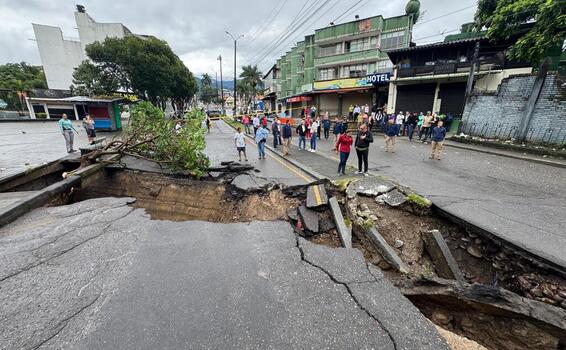
Este mes inicia la reconstrucción del puente de la avenida Alfonso López
La Administración municipal de Villavicencio confirmó que las obras de reconstrucción del pontón ubicado sobre el caño Parrado, en la Avenida Alfonso López, iniciarían antes del primero de octubre y se extenderán por un periodo de ocho meses.
El anuncio fue hecho por el alcalde Alexander Baquero durante una reunión con comerciantes de los sectores de Cielos Abiertos, Villa Julia, San Andresito y zonas aledañas, quienes han sufrido las consecuencias económicas y de movilidad tras la caída de esta estructura.
En el encuentro, el mandatario estuvo acompañado del secretario de Infraestructura, Mario Castro, y del gerente del Centro, Juan Camilo Salas, quienes detallaron que ya se encuentran listos los estudios y diseños de la obra. La financiación, precisaron, se ejecutará de manera conjunta entre la Administración Municipal de Villavicencio y la Agencia para la Infraestructura del Meta.
“Se trata de la construcción de un nuevo pontón, con una inversión que garantizará la recuperación de la movilidad y la reactivación económica del sector”, explicó Salas.
Durante la socialización también se presentó el proyecto de modernización del alumbrado público en el corredor comprendido entre Cielos Abiertos y Villa Julia. La empresa Alborada expuso los alcances y costos de la intervención, que busca mejorar la seguridad y aportar a la dinamización del comercio en esta zona estratégica de la capital del Meta.
Agregar comentario
Log in or register to post comments